
Drone Pressure Washing for High-Rise Palos Verdes Condos: Safety & Rules Explained
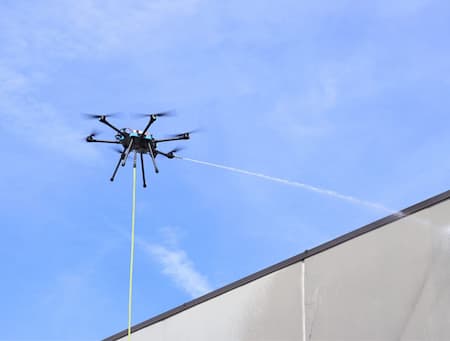
High-rise condos along the Strand and Sand Section need careful exterior care. Drone pressure washing brings the reach of a lift without blocking alleys or beach paths. This guide explains how Property Wash.com LLC plans safe flights, controls tether lines, and protects glass on coastal towers in Palos Verdes. For a deeper look at our process, see our drone pressure washing service overview.
How Drone Pressure Washing Works On Coastal High-Rises
Our wash drone carries a spray head while the pressure and water supply remain on the ground. A high-pressure hose and safety tether run to the aircraft. The ground crew manages the line with padded guides so it never rubs railings, cables, or balcony edges.
We map each elevation into vertical lanes. The pilot keeps a steady standoff while the technician feathers pressure to match cladding type. On salt-heavy days, we use a multi-stage rinse so salts and fine sand do not dry back onto glass or anodized metal.
Local Airspace, Rules, and Responsible Flight Plans
All flights are conducted by a remote pilot certified under federal small UAS rules. Depending on exact site and airspace, additional authorization may be needed before takeoff. We coordinate with property management, follow posted site policies, and schedule operations during low-traffic hours to reduce ground risk.
Our checklist covers registration, preflight inspection, and a documented risk assessment. We plan return-to-home paths that avoid people, balconies, and traffic. Never fly over people or moving vehicles. If conditions change, we pause and reassess before continuing.
Wind, Marine Layer, and Forecast Windows in Palos Verdes
The marine layer often brings cool, damp mornings with light onshore flow. As the sun breaks through, westerly winds can build and wrap around corners, especially near El Porto and along narrow Sand Section blocks. We set a firm wind limit for each façade based on height, orientation, and line exposure.
Smooth results come from timing. East or courtyard faces are cleaned first while winds are lighter. Ocean-facing walls are tackled during the best window or held for the next calm. Stop operations if winds exceed your planned limit, even if only for a single face.
Safety Perimeters That Keep People and Property Protected
Zero-liability washing starts on the ground. We build layered safety zones so no one walks under the flight path and no vehicles cross the rinse arc. These perimeters are operational standards, not a substitute for any site rules, and they adjust to the property’s layout.
- Primary exclusion zone: coned and taped area directly beneath the work lane, sized to the spray arc plus a clear buffer.
- Secondary buffer: a wider halo guiding foot and vehicle flow around corners, garage entries, and lobby doors.
- Line corridor: a protected strip from pump to façade where the hose and tether are routed and guarded.
Each zone is posted with bilingual signs and staffed by a spotter when foot traffic is likely. Block access with cones and caution tape, not just signs. If a resident must pass, we park the drone in a safe hold, secure the line, and reopen the path only after the area is clear.
Managing High-Pressure Tether Lines In Tight Sand Section Layouts
Alleys are narrow, with power meters, bike racks, and surfboard lockers close to the wall. We pre-run the hose at low pressure, add padded corners, and use line sleeves to keep the exterior unmarked. Weighted guides prevent the hose from “sawing” along stucco or tile edges during ascent or descent.
At mid-rise heights, the tether can bow in onshore wind. The ground tech adjusts slack and angle so the line trails cleanly behind the drone. Where balconies protrude, we stage low-friction rollers or soft slings, then document their placement in the job log for quick removal after the final rinse.
Protecting Delicate Glass, Fixtures, and Sealants
Coastal towers blend low-e glass, anodized railings, acrylic panels, and decorative lighting. Each surface has a safe working envelope. We choose nozzle angle, pressure setting, and flow so the stream arrives as a controlled sheet, not a pin-point blast.
Before production, we test a low-visibility panel. If we see movement in old sealant or flicker in edge lighting, we adjust the plan. Do not spray low-e or tempered glass at close range. For most façades, a surfactant-aided soft wash, followed by a long rinse, clears salt film without stressing coatings.
Crowd, Privacy, and Notice Protocols For Condo Communities
Residents expect safety and respect. We provide advance notice through the property manager and post building and elevator signs. On wash day, our cones and barricades redirect traffic, and a spotter assists anyone with mobility needs.
Camera views are set for work only. The pilot keeps the lens outward toward glass and cladding. Balconies and interior spaces are not recorded. If a private gathering or maintenance activity moves into the zone, we land and reset the perimeter before continuing.
What Property Managers Should Expect On Site, Step By Step
Here is the typical flow we follow with your onsite team so the day runs smoothly:
- Pre-site survey of façades, access points, drains, landscaping, and nearby pedestrians paths.
- Airspace and building approvals confirmed, with a simple operations plan shared with security and the front desk.
- Staging pumps, hoses, and pads; routing the line corridor; placing corner guards and balcony protection.
- Briefing with the pilot, ground tech, spotter, and property contact to review zones and hand signals.
- Test panel at low pressure; verify runoff paths and adjust detergency for salt, soot, or bird staining.
- Flight in vertical lanes with measured overlap; rinse from top to bottom to prevent streaking.
- Pause-and-pass protocol whenever a person needs escorted access through a buffer zone.
- Final rinse, demobilize guards and signs, then a walk-through with management and photo documentation.
If you want an overview of capabilities before scheduling, you can explore our process and equipment on the drone pressure washing page.
When Drones Beat Lifts and Ropes In Palos Verdes
In the Sand Section and near the Pier, curb space is limited. Aerial lifts can block alleys, require traffic control, and risk tires on soft sand after storms. Rope access adds roof wear and needs wide tie-back zones that many HOA roofs do not have.
Drones need a small staging footprint and no lane closure. They reduce worker exposure at height and keep salt mist farther from pedestrians. For glassy corners and recessed stacks common in newer condos, a pilot can set a clean approach angle without swinging a bosun’s chair. The result is faster turnaround with fewer building interruptions.
To learn about our service area and booking options, you can start from the home base here: drone pressure washing Palos Verdes. It outlines how Property Wash.com LLC supports coastal properties across the South Bay and connects you with our team.
Proof, Paperwork, and Aftercare You Can File
Property managers need records they can trust. We provide before-and-after images focused on the façade, notes on weather and wind, and a short report describing detergents and dwell times used on each surface. Filters and drains are checked so rinse water does not collect in garage inlets or planter beds.
We also note any cracked seals, loose fixtures, or paint lift observed during washing. This helps you plan maintenance and avoid surprise repairs. If we see a risk, we flag it early and adjust the wash method to protect the envelope.
Schedule a Compliant, Zero-Liability Drone Wash
Ready to set a date that fits your quiet hours and wind window? Call 310-283-9603 and mention your building’s orientation, height, and any HOA restrictions. Our team at Property Wash.com LLC will build a written plan with safety perimeters, signage, and a timed flight sequence. To move forward, start here and we will confirm the details with you: book a drone pressure washing plan for your building.
We serve Palos Verdes’s Sand, Tree, and Hill Sections with a focus on safety, speed, and a spotless finish. Your residents’ safety and privacy come first, and your building looks clean without the headache of lifts or lane closures.